

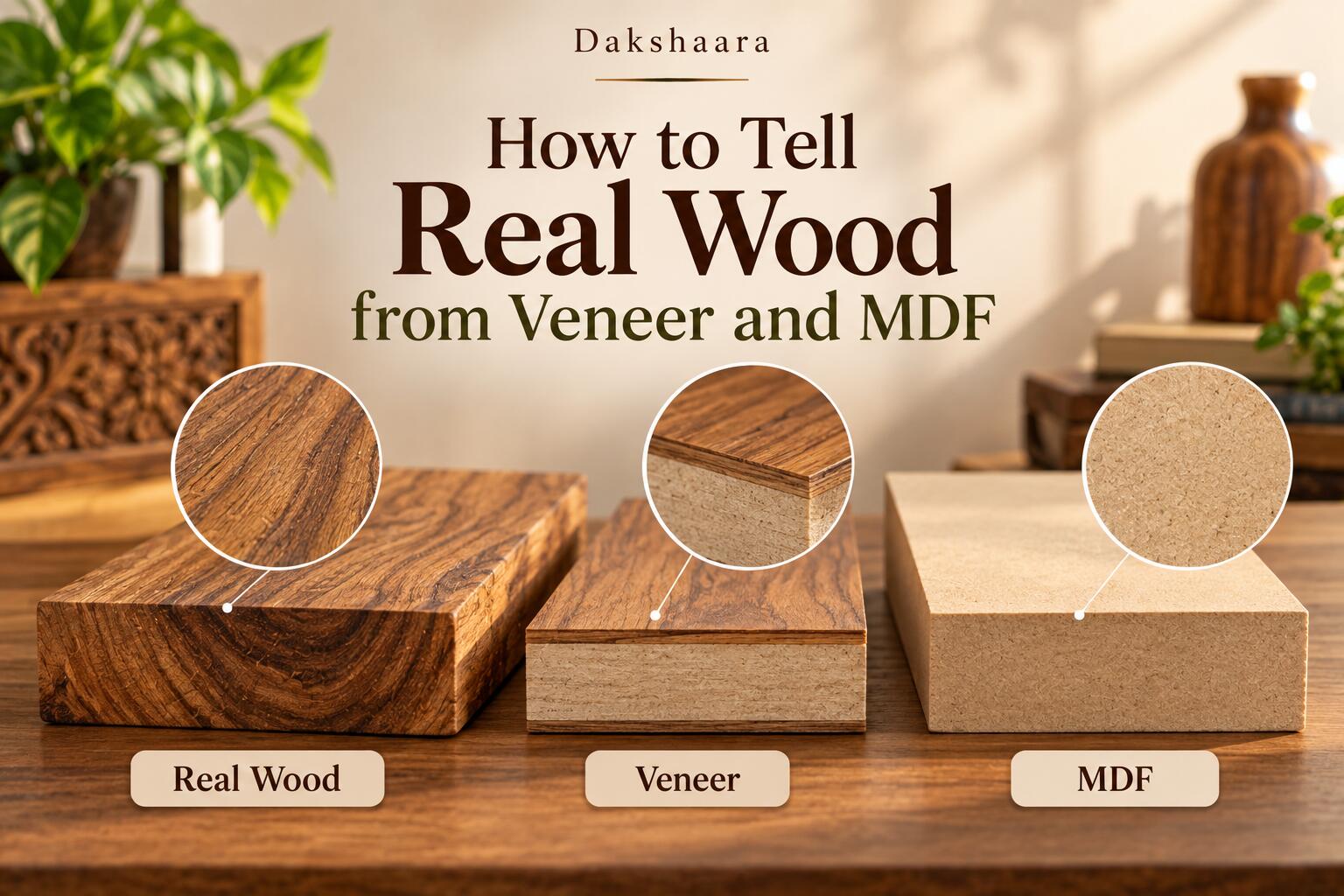

When buying furniture or wooden home décor in India, knowing how to tell real wood from veneer and MDF can help you understand what you are actually paying for. A product described as “wooden” may be made from solid timber, natural wood veneer over an engineered board, MDF with a wood-look finish, or a combination of materials.
These materials can look very similar in product photographs and showroom displays. However, checking the grain, edges, corners, surface texture and construction can reveal useful clues. This is particularly important when buying handcrafted wooden décor, furniture or higher-value pieces where material and workmanship influence the overall character of the product.
It is also important not to treat solid wood as automatically superior to every other material. Veneer and MDF have different characteristics and uses. The better choice depends on how the product is constructed, where it will be used and what you expect from it.
What Is Solid Wood?
Solid wood refers to components made primarily from natural timber rather than a manufactured wood-based board. Natural timber can show characteristics such as grain variation, knots, colour differences and small irregularities.
Common timber varieties used in Indian furniture and handcrafted décor include teak, mango and sheesham, although the actual wood species varies between products and manufacturers.
Natural variation can make every piece look slightly different. However, seeing a realistic wood pattern does not automatically prove that a product is solid wood because natural veneer can also display genuine wood grain.
The key is to examine the material beyond the most visible surface.
What Is Wood Veneer?
Wood veneer is a thin layer of natural wood applied over another material, such as an engineered wood board.
This means a veneered product can have a genuine wood surface without being made entirely from solid timber. The visible grain may therefore look completely natural.
Veneer is commonly used where manufacturers want the appearance of natural wood while using a different core material. The quality of the final product depends on the veneer, core material, construction and finishing.
If a product description says wood veneer, it should not be interpreted as solid wood.
What Is MDF?
MDF stands for Medium-Density Fibreboard. It is an engineered wood product made from processed wood fibres combined with resin and compressed into boards.
Unlike solid timber, MDF does not have the natural grain structure of a piece of wood. Its internal structure is generally much more uniform.
MDF can be painted, laminated or covered with finishes that create a wood-like appearance. As a result, a furniture piece can look wooden from the outside while having MDF underneath.
This is why checking the construction is more reliable than judging the product only by its appearance.
Solid Wood vs Veneer vs MDF
| Feature | Solid Wood | Wood Veneer | MDF |
|---|---|---|---|
| Main material | Natural timber | Thin natural wood layer over another material | Engineered wood fibre board |
| Natural grain | Yes | Visible on veneer surface | No natural timber grain |
| Appearance | Naturally varied | Natural wood appearance | Depends on surface finish |
| Edges | Natural timber may continue through the component | May reveal the underlying core | Usually uniform |
| Knots and variation | Can occur naturally | Can occur on the veneer | Usually absent unless finished or printed |
| Construction | Timber components | Wood layer + core material | Compressed wood fibres |
This comparison is only a starting point. When buying furniture or décor in India, physical inspection and the seller’s material description are more useful than appearance alone.
1. Check the Wood Grain
Grain is one of the first things to examine when identifying wooden furniture.
Natural timber usually has variation in grain direction, colour and pattern. Look closely at larger surfaces rather than judging the product from a distance.
If a wood pattern looks highly repetitive or printed, it may be a decorative finish rather than natural timber.
However, natural-looking grain can also be genuine wood veneer. Therefore, grain alone cannot confirm that the entire product is solid wood.
For a better assessment, check how the grain behaves around corners, joins and edges.
2. Examine the Edges
Edges can reveal information that a polished front surface hides.
If possible, inspect the underside, back, corners or another less-visible area. With solid wood, natural timber continues through the component. With veneer, you may be able to identify a thin surface layer over another core material.
MDF generally has a more uniform fibre-based appearance where an unfinished edge is visible.
Keep in mind that finished furniture may have painted edges, laminates or edge banding, so an edge inspection is useful but not always conclusive.
3. Check the Grain Across Corners
Look closely at areas where two surfaces meet.
On solid wood furniture, grain can continue naturally across different surfaces depending on how the timber has been cut and assembled.
Veneered products may have separate veneer sections meeting at corners or joins. Printed wood effects may also appear less natural when viewed across different surfaces.
This is a useful inspection point because it helps you compare the visible surface with the overall construction rather than judging one flat area.
4. Feel the Surface Texture
Run your hand gently across the surface.
Natural wood can have subtle differences in texture because of its grain and finishing process. MDF with a smooth laminate or painted surface may feel more uniform.
Veneer can also feel like natural wood because the visible layer is actual wood.
Surface texture can therefore provide a clue, but it should be considered together with the grain, edges and material description.
5. Look at the End Grain
End grain refers to the appearance of wood fibres at a cut end.
When visible, it can provide useful information about natural timber. Solid wood components can show the structure of the timber at their ends, while MDF has a different fibre-based appearance.
On veneered furniture, the visible surface may be natural wood while the underlying core is different.
For this reason, an unfinished or less-visible area can sometimes tell you more about construction than the front surface.
6. Don’t Use Weight as Proof
Weight can provide a clue, but it is not a reliable standalone test.
Different timber species have different densities. MDF also has its own density, while veneered furniture can vary depending on the material used underneath the veneer.
So the assumption that “heavy means solid wood” is too simplistic.
Two products with similar dimensions can have different weights because of their materials, construction and design.
Use weight as one observation rather than proof.
7. Look for Natural Variation
Natural timber can contain:
- Small knots
- Changes in grain direction
- Colour variation
- Minor texture differences
- Natural markings
These characteristics can contribute to the individuality of handcrafted wooden décor.
However, natural imperfections do not automatically prove that a product is solid wood. A natural wood veneer can also contain genuine knots and grain variation.
The better approach is to consider the complete construction rather than relying on one visual characteristic.
8. Inspect the Underside and Back
When buying furniture or larger wooden décor pieces, the front is usually the most carefully finished area.
If the seller allows inspection, look underneath, behind and inside the product.
These areas may reveal:
- The underlying board material
- Veneer edges
- Joinery
- Surface layers
- Differences between visible and hidden areas
For Indian furniture purchases, especially when buying directly from a showroom, workshop or artisan, asking to see these areas can give you a clearer understanding of the construction.
9. Ask the Seller Specific Questions
One of the easiest ways to avoid confusion is to ask the seller exactly what material has been used.
Instead of simply asking:
“Is this wooden?”
ask:
“Is this solid wood, wood veneer over an engineered board, or MDF?”
You can also ask:
- What wood species is used?
- Which parts are solid wood?
- Is any section veneered?
- Is MDF used anywhere in the product?
- What material is used for the back or base?
- What type of finish has been applied?
For online purchases, check the product description carefully before ordering. If the listing only says “wooden” without explaining the material or construction, ask the seller for clarification.
This is especially useful when comparing handcrafted décor, furniture and other higher-value wooden products from Indian sellers.
Why Material Matters When Buying Wooden Home Décor
Material is only one part of product quality.
When choosing wooden home décor, also consider:
- Craftsmanship
- Joinery
- Surface finishing
- Stability
- Design
- Intended use
- Maintenance requirements
- Overall construction
A solid wood product is not automatically the right choice for every application, just as MDF is not automatically unsuitable.
For handcrafted décor, craftsmanship and finishing can be particularly important because small differences in grain, surface treatment and construction contribute to the character of the finished piece.
The material should therefore be evaluated alongside the product’s purpose and construction.
What to Look for in Handcrafted Wooden Décor
Handcrafted wooden products can naturally vary from one piece to another.
Differences in grain, tone and small surface characteristics may occur because natural timber is not completely uniform. These variations are not necessarily defects.
For a handcrafted home décor piece, look at the material information together with the craftsmanship and overall design.
At Dakshaara, handcrafted home décor and traditional-inspired pieces are approached as products where material, design and craftsmanship work together to create the final character of the piece. When evaluating a Dakshaara product or any other wooden décor item, read the product description carefully and check the material information provided for that specific product.
Don’t Judge a Product by the Word “Wooden”
The word “wooden” is a broad description. It does not tell you whether a product is:
- Solid wood
- Wood veneer
- MDF with a wood-look finish
- Another engineered wood product
- A combination of different materials
This distinction matters when you are comparing products and prices.
Instead of relying on the word “wooden”, check the actual material description and construction.
For online shopping in India, this is particularly important because product photographs can make different materials look almost identical. If the material information is unclear, contact the seller before purchasing.
A Simple 5-Point Wood Inspection Check
If you want a quick way to inspect a wooden product before buying, remember these five checks:
1. Grain – Does the surface show natural variation?
2. Edges – Can you identify what material is underneath the visible surface?
3. Corners – Does the grain and surface treatment make sense across joins?
4. Texture – Does the surface feel natural, laminated or highly uniform?
5. Description – Does the seller clearly identify the actual material?
No single observation can reliably identify every material. Combining several checks with the seller’s material information gives you a much clearer picture.
Final Thoughts
Knowing how to tell real wood from veneer and MDF can help you make more informed decisions when buying furniture and wooden home décor in India.
The biggest mistake is assuming that appearance tells you everything. Solid wood, natural veneer and MDF can all be finished attractively, and photographs often cannot reveal the underlying construction.
Look at the grain, inspect edges and less-visible areas, check the texture, consider the construction and ask the seller specific material questions.
Most importantly, remember that solid wood, veneer and MDF are different materials rather than simply a ranking from good to bad. The right option depends on how the product is made, how it will be used and what you expect from it.
When choosing handcrafted décor, consider the material alongside craftsmanship, design and intended use. That gives you a much more practical basis for deciding whether a piece is right for your home.
Leave a Reply